













M INFO@GALERIEVOSS.DE
T +49 (0)211 13 49 82
F +49 (0)211 13 34 00
GALERIE VOSS MÜHLENGASSE 3 40213 DÜSSELDORF
IMPRINT
VOSS GALLERY
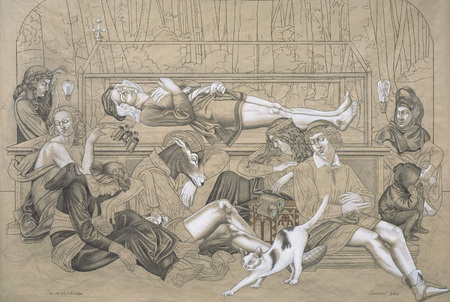
Notes on the Work of Frank Sämmer
By Kurt Hübner, Kiel
Historical classification
From antiquity to the baroque and rococo periods there was something like a global style, which means that this style, though changing, once and again appeared uniformly with every artist contributing their personal versions. This is because each epoch was determined by a nearly uniform conception of reality – antiquity by myth and the following epochs by Christianity. Only when the universal concept of reality allowed for variants of the same thing were there stylistic changes within the various global styles: in antiquity the archaic, the classical and the Hellenistic styles, in the Middle Ages the Romanesque and the Gothic styles. In contrast to this, in the baroque period the neo-Platonic idea of the beautiful as the emanation of the one God (predominant in the Renaissance) turns into the demonstration of ephemeral vanity and, finally, changes into a merely artificial and playful illusion in the rococo period.
Since the nineteenth century there has not been any uniform European style. The antique-Christian basis of the West with its mythical-religious background was shaken by the Enlightenment; the scientific-technological civilization took its course. The place of the absolute came to be occupied by the individual, the free and self-conscious Cartesian who, by nature, tackled reality only hypothecially, experimenting and constructing and thus continuously enlarging the range of views.
While impressionist art fell to the charm of empiric perceptibility, which was also determined by the scientific physiology of the senses, the cubists conceived reality as the result of term-creating rationality. Cubism is an “Art conceptuel”, it does not only present what we see of an object but also iwhat we know like its volume, its outer and inner surfaces, its front and back etc.. This is continued by the constructivist-abstract painting of the so-called “Stijl”, which merely shows the aestheticism of geometrical forms. Pop-art, which mainly deals with the consumer goods produced by the scientific-technological world, belongs there, too.
There was, however, also that art which understood itself as a rebellion against these manifold expressions of a rationalist basic attitude. Just think of surrealism, dadaism and expressionism. Surrealism hints at the reverse side of the Cartesian: psychoanalysis discovered the unconscious and its dream symbols. The cartesian world of reason, logic and the total explanation of the world by means of causality is, to the dadaist, only an appearance behind which the true reality hides. The expressionist, at last, abolishes the modern division between objectivity and subjectivity and returns to the mythical unity of the ideal and the material things. The stylistic devices of surrealism are as manifold as dream symbols and, since the dream is, more or less, a random repetition of past experiences, they are often based on quotations from past worlds. Dadaism´s main stylistic device, however, in spite of all its different appearances, is the so-called “objet trouvé”, which manifests chance and makes any object a riddle by depriving it of all conceptual and rationalist connections. The stylistic devices of expressionism, though, bring about a passionate excitement of colours and shapes. Thus, anything representational and sensual, no matter whether ideal or material, reflects spiritual, lyrical or dramatic occurrences.
Considering the latest state of current painting, which might be called ultra-modern, one may say it declines the prime idea of art, which was the visualization (and perhaps critical counteraction) of reality as a condition of the world under given historical circumstances. Endeavouring to bring everything into the light of thoughtful rationality, it finally loses the connection with reality at all except for the reality of perpetual self-reflections. Art turns into a mere manifestation of the individual´s absolute freedom, into a more or less arbitrary and subjective play with objects and signs.
In contrast to that, Sämmer´s art perhaps means a fresh start at the end of the long way art has come until today because it breaks away from this narcissistic dispostion of contemporary art: it displays a new reality that may be regarded as the resultant of those different views of reality outlined here. Certainly not in the form a some eclecticism but as a stage of reflection which is aware of the historical nature of any concept of reality including modern rationality. It has nothing to do with the idea of progress predominant today nor with subjectivistic relativism but says that the various historical periods are just different facets in the mystery of the one reality that can only be perceived through images, allegories, ironical alienation and questionable backgrounds. Moreover: in this mystery of a reality which includes all historical periods, even its rational order defined by classifications like inorganic-organic, plant-animal-man etc. will disappear. All these elements are, on the contrary, connected with each other in a mysterious, puzzling and basically incomprehensible way. The contemporary rationalism has lost the way towards a deeper reality, the contemporary inndividualism has abandoned the search for it at all. Sämmer is earching for it again without surrendering to deceitful convictions.
Picture types in Sämmer´s work
Three picture types from Sämmer´s work may illustrate what has been said so far.
They concern the themes of “The modern world of economy”, “Eroticism”, “The sacred” and “Knighthood”.
As for the first theme, I choose the picture “Ankunft der Optimierer” (“Arrival of the Optimizers”). It shows three young men typical of the modern functional business elite. Dressed in elegant modern suits, they step down into the picture from above, competent and absolutely self-assured as if bringing a new order to the world. The world, however, is represented by a medieval town with a cathedral towering above it; two women in medieval garments can be seen praying piously. They give the impression that they are expecting a message of salvation from the three men. A large bird sits between them. Is it one of the birds of ancient legends that proclaim wisdom? In this medieval town, however, we also see signboards of Siemens, VW and others; one of them, in the centre of the picture, indicates the European currency. In the foreground, a naked woman sits with birds on her shoulders and at her feet, too, but the birds are of a totally different, rather playful kind than the “ bird of wisdom” between the praying women. The naked woman turns her back on the men and women described before as if she had nothing to do with them. The men, though, are accompanied by a tiny stag; flames leap out of its antlers and follow its trail, too. Is this not a clue that the women are wrong expecting divine blessings from the “optimizers”? Does not the burning animal world (and thus the prime world) insinuate that they bring evil with them, even though it may be subliminal yet as compared with the “optimizers”, whose appearance overtops everything? The eternal meaning of eroticism and the birds´ world connected with it through ancient symbols remains untouched.
Sämmer has devoted lots of pictures to the subject of eroticism.
One of them he calls “Arkanum”, mystery. A naked and winged woman sits in the centre, once again with symbol birds at her feet as mentioned before. Apparently absorbed in dreamy thoughts, she sits at right angles to a rather biedermeier-like street idyll; a toy plane and a toy knight hover around her. Might we not think that all these objects (which summarize the history of civilization) circle around her because they are just playthings in comparison with Eros, although everything has been revolving about Eros from the beginning? Yet, has the woman not been taken from the superficial world of pop-art like a pinup girl, when you consider her two-dimensionality and her dyed blue hair? Does the Arkanum perhaps mean that the eternal omnipotence of Eros has been self-alienated, which then, however, would refer back to the essential, its eternal mystery?
Sämmer´s painting “Vogelhochzeit” (“Bird Wedding”) shows another view of Eros. There is a reclining naked woman, who reminds one of Botticelli´s mythical female figures. In her lap birds have gathered and an Eros-putto plays with them on her belly. The woman lies on a flowered lawn fenced in by roses. A wall marks off the paradisiacal scene while a sunset glow announces the night (of love?). Thus the whole picture seems to prove the original myth of Eros. And yet, even in this picture we recognize Eros only allegorically because, in this connection, myth, too, is merely one among other past attitudes that have their source in the deeper, incomprehensible first cause of the universe.
Sämmer´s pictorial treatment of the sacred is similar. Like the antique myth of Eros, which he allegorically relates to the puzzling universal mystery at its bottom, he alienates the sacred to grasp it in a picture.
His picture “Tabu” (“Taboo”) may demonstrate this. There is an angel locked out behind bars. His hair seems to be ablaze like the prophets´ hair in many a picture from art history, but the pale-pink flames rather resemble the shine of neon lights, and so even a withered leaf suggesting something gone could lose itself in that shine as if blown there by the wind. Moreover, the angel is tied to the grating with barbed wire. With his head sadly bent and his eyes closed he seems to be asleep. On the other hand, he is most beautiful. His wings are brightly coloured and, in contrast to the withered leaf, shining green leaves entwine his hair. Thus the sacred is mirrored in a world strange to it now as the painful but wonderful manifestation of being lost and shut out.
The picture “Herr H. als Prinz Désir” (“Mr. H. as Prince Désir”) is perhaps Sämmer´s most impressive representation of the Christian sacredness in the light of modern science. Scantily dressed, Prince Désir falls to the earth like the damned in pictures of the Last Judgement are thrown into hell. During the fall, his crown falls to the ground where rats have gathered – everything symbolizes ephemeral vanity. Top left in the background above him, a man stands, the optimizer type from the picture interpreted before. And in this picture, too, there is an animal next to him, this time a burning cow with the flames licking around the man. This time, however, the “optimizer” does not show off high-handed but seems to be reporting to someone, via cellular phone, of Prince Désir´s sudden fall. On the right, level with the “optimizer”, two angels can be seen; two owls, the mythical birds of wisdom, perch in front of them. The angels have sky-blue wings, they wear sky-blue robes and they are of a Raphael-like heavenly beauty. Either looks, with calm certainty, at what is happening, the other, with his hand on the owl´s head, has assumed the pose of the anxious guardian angel while looking at the flames. Prince Désir, an exponent of the general hedonism (désir) associated with the “optimizer”, is surrounded by oversized animals, which he does not notice at all, though. Are they personifications of mysterious nature? A nature that has no place in the Prince´s economic-hedonic world although it is mysteriously effective in it?
The subject of “Ritter” (“Knighthood”), finally, is connected with the sacred. This is because Sämmer´s various knight pictures are variations of St. George the dragon-slayer and the incarnation of medieval courtly love, which cannot be separated from Christian love, agape. Sämmer´s dealing with this love in its exclusively medieval context may well be explained by a reference made before: he regards the historical periods – in contrast to their now wide-spread interpretation in terms of progress and relativism – as facets only of the one mystery covering all reality but never solvable. Antiquity with its festive character of Eros and the Middle Ages with their mystic Christian courtly love seem to turn into symbols; both, however, are allegorically alienated so as to indicate a lost reality that appeals to us forcefully just because it is irretrievably lost.
I choose two pictures to illustrate this idea. One is entitled “Ablösung” (“Relief”), the other “Erinnerungen an Bern” (“Memories of Bern”).
In the middle of “Relief” there is, lonely in the snow, a knight in glinting armour with a bluish tinge leaning against a tree. He has assumed, with body and hands, a slightly bent pose, which can often be seen with Gothic figures. His eyes are closed. Is he asleep or dreamily awake? The tree against which he is leaning is dead like all the trees around, but it still testifies former power and strength. Farther back, however, we see a green coniferous wood and, in the far background, steeply rising mountains. It is a clear sunlit winter day. Another knight, still far away, comes riding up from the valley – is he the relief? Is the extinct world of Christian courtly love waiting for its revival (in whatsoever form) in a time that has changed totally? In the picture “Memories of Bern” we see a sleeping knight, too, this time in a thicket. Rats, symbols of decay, play at his feet. The forefinger of his left hand points in a direction, though. Above him, at a distance, a modern-dressed man on horseback has forced his way into the virgin forest. He, too, is accompanied by a bird of wisdom like the one sitting next to the sleeping knight but much smaller. Yet he cannot see the knight with the pointing finger. The world of chivalry is definitely gone. And yet, it has an eternal meaning because of the sacred character of agape for which the knights fought and the eternal mystery they pursued. Is it that mystery for which our modern world is, perhaps, still unconsciously searching, even though in a changed form?
Sämmer´s stylistic means
As was demonstrated before, his subject is the rational and functional modern world. Its belief in progress is coupled with an unlimited individualism and relativism. The past is regarded as finished. Dialectically, the belief in progress changes into a universal mystery. So, in Sämmer´s work, the mystery appears exactly as it is mirrored in the modern view of reality, namely as a rational design devoted to modernity: clear-view purity in the clearest and brightest light, so-to-say in a vacuum, nowhere anything blurred but sharp contours and unmixed brilliant colours, the predominance of the surface and, therefore, the absence of three-dimensional depth and, as a result, complete superficiality. (This absence of three-dimensionality more or less ideally outdoes the rationality of the modern view of dimensionality). On the other hand, Sämmer abolishes – due to his concept of history – the chronological order peculiar to the modern world, which strictly separates the past, the present and the future from each other: he connects quotations from past times with requisites of the present in one composition. Finally: according to the neo-Platonic philosophy, which was predominant during the Renaissance, the divine idea of the beautiful appears in the sensual world through emanation and thus becomes the subject of art as “perfetta cognizione dell´oggetto”. In Sämmer´s work, too, the mystery of the world appears in the form of beauty, which not only concerns the persons presented but also the formal design devoted to the clear and strict rationality of modernity. Both the beautiful in the classical sense and this kind of pictorial representation are unsolvably connected with each other; obvious contradictions (the mystery of the beautiful seems to be incompatible with the matter-of-fact rationality of modernity) adapt themselves to a universal harmony and apodictic picture logic. Apodictic, because it is possible only by visualizing shapes and their relationships, and logical because of an inherent sensual consistency, which we know outside art to be also a question of taste.
All this is based on a perfect mastership of the artist´s trade and tools. Art has been characterized so since its first beginnings. For, it was always art´s unique mission (in historical or situational and, therefore, different realities and by means of laborious procedures characteristic of art only) to detach its respective subjects from their direct and manifold connections
(be they of a practical, cognitive, emotional or whatsoever nature) and present their visible properties in their given historical reality (1), which is exactly what modern art has mostly abandoned.
Definitions are free now, and so, whatever you consider to be art depends on you.
There is, however, no denying that art´s ancient mission to present the visible in an historical reality as such, indeed, spiritualizes its sensual appearance because it removes the visible from its scattered plasticity, which serves rather crude, more or less coincidental and mostly practical purposes usually guiding us in life, and thus comprehends the essential things in it.
In this sense, art is unsolvable connected with laboriously acquired ability.
(1) Cf. K.Hübner, Die zweite Schöpfung. Das Wirkliche in Kunst und Musik, III. Kapitel, München 1994
Catalogue available.
 |
|
| Test May 09, 2019 - May 09, 2019 |
|
|
| Kay Kaul | Cloudbusting Mar 08, 2019 - Apr 27, 2019 |
|
|
| Jurriaan Molenaar | Fermate Jan 18, 2019 - Mar 02, 2019 |
|
|
| Harding Meyer / Humanize Oct 19, 2018 - Jan 12, 2019 |
|
|
| Mihoko Ogaki / Soft Landing Aug 31, 2018 - Oct 13, 2018 |
|
|
| Iwajla Klinke / ONEIRONAUTS Jun 08, 2018 - Aug 18, 2018 |
|
|
| Peter Uka / Fragment of the Present Passed Apr 13, 2018 - May 26, 2018 |
|
|
| Daniel Heil / Monologues Mar 09, 2018 - Apr 07, 2018 |
|
|
| Düsseldorf Photo Weekend 2018 Feb 16, 2018 - Feb 18, 2018 |
|
|
| Sandra Senn / Zwischen Zwei Meeren Jan 26, 2018 - Mar 03, 2018 |
|
|
| Frank Bauer / Die Gelassenheit der Dinge Nov 17, 2017 - Jan 20, 2018 |
|
|
| Kate Waters / Whistling In The Dark Sepr 01, 2017 - Nov 11, 2017 |
|
|
| Untitled Jul 12, 2017 - Aug 02, 2017 |
|
|
| Davide La Rocca / 13K ( Part 1 ) May 12, 2017 - Jun 27, 2017 |
|
|
| Sandra Ackermann / Lost in Nothingness Mar 24, 2017 - May 06, 2017 |
|
|
| Claudia Rogge / CONCENTRATION Jan 27, 2017 - Mar 18, 2017 |
|
|
| Christian Bazant - Hegemark / The Rise and Fall of Transformative Hopes and Expectations Nov 11, 2016 - Jan 21, 2017 |
|
|
| Harding Meyer / The Others Aug 26, 2016 - Nov 05, 2016 |
|
|
| Crossing Borders Jun 03, 2016 - Jul 15, 2016 |
|
|
| Sandra Senn / Flüchtiges Getriebe Apr 08, 2016 - May 21, 2016 |
|
|
| Iwajla Klinke / Red Sandals and a Mirror for Gabriel Feb 12, 2016 - Mar 26, 2016 |
|
|
| Corrado Zeni / Éloge de la fuite Nov 27, 2015 - Jan 09, 2016 |
|
|
| Claudia Rogge / PerSe Oct 16, 2015 - Nov 21, 2015 |
|
|
| Kate Waters // Tell it like it is Aug 28, 2015 - Oct 10, 2015 |
|
|
| Visions Of Sensory Space ( by Weightless Artists Association - SPARTNIC ) May 15, 2015 - Jul 04, 2015 |
|
|
| Sandra Ackermann / Wasteland Mar 13, 2015 - May 02, 2015 |
|
|
| Lost Scapes Jan 30, 2015 - Mar 07, 2015 |
|
|
| Christian Bazant-Hegemark / Calibrating Aesthetics Nov 14, 2014 - Jan 17, 2015 |
|
|
| Frank Bauer / Back to Basics Aug 29, 2014 - Nov 08, 2014 |
|
|
| Harding Meyer // recent paintings May 23, 2014 - Aug 23, 2014 |
|
|
| Till Freiwald - memoria Apr 11, 2014 - May 17, 2014 |
|
|
| Quadriennale Düsseldorf 2014 / Gallery Evening Apr 05, 2014 - Apr 05, 2014 |
|
|
| Iwajla Klinke / Ritual Memories Jan 17, 2014 - Apr 05, 2014 |
|
|
| Giacomo Costa // Traces Nov 22, 2013 - Jan 11, 2013 |
|
|
| DC-Open Galleries: Matthias Danberg - Inventory by Appropriation Sepr 06, 2013 - Nov 16, 2013 |
|
|
| Christian Bazant-Hegemark // VOW OF SILENCE May 24, 2013 - Aug 20, 2013 |
|
|
| Corrado Zeni // Generation Why Apr 12, 2013 - May 18, 2013 |
|
|
| behind the Non-Colours Mar 22, 2013 - Apr 06, 2013 |
|
|
| Sandra Ackermann // Running to stand still Feb 15, 2013 - Mar 16, 2013 |
|
|
| Düsseldorf Photo Weekend 2013 Feb 01, 2013 - Feb 09, 2013 |
|
|
| Mihoko Ogaki // Star Tales - White Floating Nov 30, 2012 - Jan 31, 2013 |
|
|
| Claudia Rogge / Lost in Paradise Oct 12, 2012 - Nov 24, 2012 |
|
|
| Harding Meyer // features Sepr 07, 2012 - Oct 06, 2012 |
|
|
| Summer 2012 - Part 2 Aug 10, 2012 - Sepr 01, 2012 |
|
|
| Summer 2012 Jul 06, 2012 - Sepr 01, 2012 |
|
|
| Maria Friberg // The Painting Series May 11, 2012 - Jun 23, 2012 |
|
|
| Mary A. Kelly // Father & Child Mar 30, 2012 - May 06, 2012 |
|
|
| Maia Naveriani // Future Wolves and Chicks so far Feb 10, 2012 - Mar 24, 2012 |
|
|
| Düsseldorf Photo Weekend 2012 Feb 04, 2012 - Feb 08, 2012 |
|
|
| Kate Waters // The Air that I breathe Dec 09, 2011 - Jan 28, 2012 |
|
|
| Frank Bauer / ...den Wald vor lauter Bäumen.... Nov 04, 2011 - Dec 03, 2011 |
|
|
| Claudia Rogge // Final Friday Sepr 09, 2011 - Oct 29, 2011 |
|
|
| Davide La Rocca - STILLS May 27, 2011 - Jul 16, 2011 |
|
|
| Giacomo Costa // Post Natural Apr 01, 2011 - May 21, 2011 |
|
|
| Harding Meyer - to be a real vision Feb 18, 2011 - Mar 26, 2011 |
|
|
| Shannon Rankin - Disperse / Displace Dec 03, 2010 - Feb 12, 2011 |
|
|
| Sandra Ackermann // I look inside you Oct 15, 2010 - Nov 27, 2010 |
|
|
| Amparo Sard / AT THE IMPASSE Sepr 03, 2010 - Oct 09, 2010 |
|
|
| Kate Waters // The Land of Kubla Khan Jun 11, 2010 - Jul 17, 2010 |
|
|
| Jurriaan Molenaar // Lessness Apr 30, 2010 - Jun 05, 2010 |
|
|
| Claudia Rogge // The Paradise of the Onlooker Mar 05, 2010 - Apr 24, 2010 |
|
|
| Ivonne Thein // incredible me Jan 22, 2010 - Feb 27, 2010 |
|
|
| Frank Bauer // Jet Set Nov 27, 2009 - Jan 15, 2010 |
|
|
| Michael Koch // forever more Oct 23, 2009 - Nov 21, 2009 |
|
|
| Masaharu Sato // SIGNS Sepr 04, 2009 - Oct 17, 2009 |
|
|
| Harding Meyer // blind date Jun 19, 2009 - Aug 22, 2009 |
|
|
| Maria Friberg // way ahead Apr 24, 2009 - Jun 13, 2009 |
|
|
| Claudia Rogge // Isolation ( aus: Segment 8 - die Blasen der Gesellschaft) Mar 06, 2009 - Apr 18, 2009 |
|
|
| Claudia Rogge - The Opening Mar 06, 2009 - Apr 18, 2009 |
|
|
| JoJo Tillmann // What you see is what you get Jan 30, 2009 - Feb 28, 2009 |
|
|
| Sandra Ackermann // Die Wirklichkeit ist nicht die Wahrheit Nov 21, 2008 - Jan 24, 2009 |
|
|
| Kate Waters - Getting used to the 21st Century Oct 10, 2008 - Nov 15, 2008 |
|
|
| Mihoko Ogaki - Milky Ways Sepr 04, 2008 - Oct 04, 2008 |
|
|
| Summer 2008 // Painting Aug 12, 2008 - Aug 30, 2008 |
|
|
| Silke Rehberg: Stationen 1,4,6,7,11,12,13,14 Jun 13, 2008 - Jul 12, 2008 |
|
|
| Maia Naveriani: At home with good ideas May 09, 2008 - Jun 07, 2008 |
|
|
| Justin Richel: Rise and Fall Apr 04, 2008 - May 03, 2008 |
|
|
| Davide La Rocca - Strange Object Feb 08, 2008 - Mar 28, 2008 |
|
|
| Frank Bauer: AkikoAlinaAlinkaAndrew.... Nov 30, 2007 - Feb 02, 2008 |
|
|
| Maria Friberg: Fallout Oct 12, 2007 - Nov 24, 2007 |
|
|
| Harding Meyer / in sight Sepr 06, 2007 - Oct 11, 2007 |
|
|
| SUMMER '07 Jul 17, 2007 - Sepr 01, 2007 |
|
|
| Kay Kaul - Wasserfarben Jun 15, 2007 - Jul 14, 2007 |
|
|
| Sandra Ackermann - Point Blank Mar 02, 2007 - Apr 28, 2007 |
|
|
| Tamara K.E.: pioneers -none of us and somewhere else Jan 19, 2007 - Feb 24, 2007 |
|
|
| Till Freiwald Nov 17, 2006 - Jan 13, 2007 |
|
|
| Claudia Rogge: U N I F O R M Sepr 01, 2006 - Nov 11, 2006 |
|
|
| Frank Sämmer: Die Stunde des Zaunkönigs Jun 23, 2006 - Aug 22, 2006 |
|
|
| Kate Waters: Killing Time May 05, 2006 - Jun 17, 2006 |
|
|
| Katia Bourdarel: The Flesh of Fairy Tales Mar 31, 2006 - Apr 29, 2006 |
|
|
| Mihoko Ogaki Feb 10, 2006 - Mar 18, 2006 |
|
|
| Silke Rehberg: RICOMINCIARE DAL CORPO Jan 27, 2006 - Feb 26, 2006 |
|
|
| Sandra Ackermann Dec 08, 2005 - Jan 15, 2006 |
|
|
| Corrado Zeni Dec 04, 2005 - Jan 11, 2006 |
|
|
| Frank Bauer Nov 18, 2005 - Jan 15, 2006 |
|
|
| Harding Meyer Oct 07, 2005 - Nov 12, 2005 |
|
|
| AUFTAKT Sepr 02, 2005 - Oct 01, 2005 |
|
|
| Claudia Rogge: Rapport Jun 17, 2005 - Jul 20, 2005 |
|
|
| May 13, 2005 - Jun 11, 2005 |
|
|
| Kate Waters: Solo-Exhibition in the Gallery Thomas Cohn, Sao Paulo Apr 16, 2005 - May 20, 2005 |
|
|
| Vittorio Gui: FROZEN MOMENTS Apr 08, 2005 - May 07, 2005 |
|
|
| Kay Kaul - ARTSCAPES Apr 03, 2005 - May 29, 2005 |
|
|
| SEO Geheimnisvoller Blick Mar 04, 2005 - Apr 02, 2005 |
|
|
| Claudia van Koolwijk at Museum Bochum Feb 26, 2005 - Apr 17, 2005 |
|
|
| Corrado Zeni - Six Degrees of Separation Nov 26, 2004 - Jan 15, 2005 |
|
|
| Maia Naveriani: What' s the difference between ME and YOU? Oct 15, 2004 - Nov 20, 2004 |
|
|
| Tamara K.E.: MAD DONNA AND DONNA CORLEONE Sepr 03, 2004 - Oct 09, 2004 |
|
|
| Davide La Rocca: Real Vision Reflex Jun 12, 2004 - Jul 17, 2004 |
|
|
| Kay Kaul COLLECTORSCAPES Apr 23, 2004 - Jun 05, 2004 |
|
|
| Frank Sämmer MUTABOR Mar 12, 2004 - Apr 17, 2004 |